Nashville Barnwood Telecaster
.JPEG)
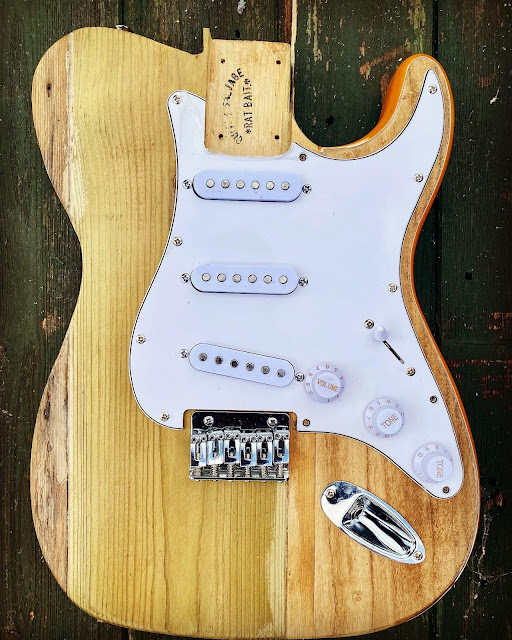
A shadow stirs where once there was only dust and silence. This is no mere instrument born of industry’s cold machinery—it is a resurrection, hewn from the spectral remnants of forgotten places. Barnwood weathered by unspoken years, roofing timber that has tasted the sorrow of storms, even the forsaken bones of a garden bench—all gathered, all reborn, all compelled into new form. A Tele-shaped relic, singular and unrepeatable, wrought in the dim workshops of Rat Bait Guitars in the UK, where craft borders on conjuration.
Its lineage whispers of Nashville’s classic Tele, yet it walks with a swagger unmistakably its own—right-handed, six-stringed, twenty-two frets of pale maple touched with a faint, ghostly nitro finish, as though time itself had laid its hand upon the neck. And as every revenant must be carried from one realm to the next, it arrives with its own humble gig bag, ready to haunt whatever stage or chamber dares to receive it.
.JPEG)
This one isn’t pretending to be a museum piece. It’s built the way a real working guitar should be: rough‑edged, smooth‑playing, and ready for sweat, gigs, and long nights. No sterile perfection. No factory gloss. Just a solid, honest instrument with the kind of attitude you only get from reclaimed timber.
- Tele bridge pickup + single-coil middle + Tele neck pickup
- 3-way switch
- Grey pearl pickguard with real battle scars from its previous life
Specs:
- Scale length: 25.5
- Nut width: 42mm
- Body thickness: 44mm
- Weight: 3.6kg
- 10mm machine heads, strap buttons
A guitar of reclaimed timber, bearing the quiet sorrows and survivals of its former life, stood now in the likeness of a Tele—its character shaped by distant echoes of those curious Japanese makes of the sixties and seventies, Jedson among them. To the seeker of singular things, whose grain and fibre whisper of journeys already taken, this instrument would seem a fated encounter rather than a mere purchase.
Fashioned in the Nashville manner, it was one of those creations that, from the first marriage of its parts, appeared destined to be whole. Some subtle congruence of form and function—its pliancy, its sharp-tongued brightness, the natural settlement of its weight upon the player—conspired to make it both a pleasure to bring into being and a truer pleasure still to set ringing beneath the hands.

Comments
Post a Comment